Showing posts with label Liturgical Year. Show all posts

Monday, April 23, 2012

St. George's Looks Towards Christmas

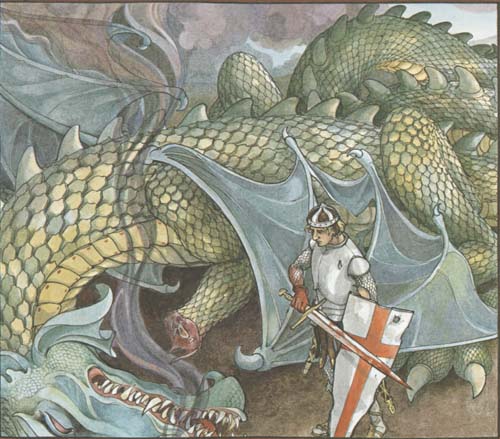
Yes, we are a Scottish family, but we do love Saint George of Merry England. In fact, the first book we ever bought for our daughter was the classic children's book by Margaret Hodges and Trina Schart Hyman---a great author/illustrator combo. The book is great for boys or girls, since it has a beautiful female character named Una as well as the noble and fearless Saint George. To my mind, there are two things that make this book extra special:
  1. The illustrations are spectacular. Not only are the actual pictures amazing, but each page has intricately designed borders with flowers, symbols and depictions of events in the book. And perhaps best of all, St. George is no pretty boy, and the dragon is actually ferocious, just like a dragon should be.
  2. The book really lends itself to out-loud, dramatic reading. There's one page (page 15 in our copy) that is just a long paragraph describing the dragon in detail, with such great descriptions as, "He reared high, monstrous, horrible, and vast, armed all over with scales of brass fitted so closely that no sword or spear could pierce them...His head was more hideous than tongue can tell, for his deep jaws gaped wide, showing three rows of iron teeth ready to devour his prey. A cloud of smothering smoke and burning sulfur poured from his throat, filling the air with its stench..."  And that's only half of it!
And on the more adult end of things, there are some great traditions associated with Saint George's feast day. One of the great customs is to make dandelion wine for Christmas. If anyone here in Phoenix knows of a large dandelion pasture, please do let us know. We've seen lots of cactus blossoms lately, but not much in the way of dandelions. Perhaps some day we will grow our own field of dandelion "weeds," just so we can make this recipe:


2 qts dandelion flowers
3 lbs granulated sugar
4 oranges
1 gallon water
yeast and nutrient

(From the site): This is the traditional "Midday Dandelion Wine" of old, named because the flowers must be picked at midday when they are fully open. Pick the flowers and bring into the kitchen. Set one gallon of water to boil. While it heats up to a boil, remove as much of the green material from the flower heads as possible (the original recipe calls for two quarts of petals only, but this will work as long as you end up with two quarts of prepared flowers). Pour the boiling water over the flowers, cover with cloth, and leave to steep for two days. Do not exceed two days. Pour the mixture back into a pot and bring to a boil. Add the peelings from the four oranges (again, no white pith) and boil for ten minutes. Strain through a muslin cloth or bag onto a crock or plastic pail containing the sugar, stirring to dissolve. When cool, add the juice of the oranges, the yeast and yeast nutrient. Pour into secondary fermentation vessel, fit fermentation trap, and allow to ferment completely. Rack and bottle when wine clears and again when no more lees form for 60 days. Open and drink for Christmas.

Until that day, we plan to have a delicious dinner of roast beef and Yorkshire pudding to honor dear Saint George. Here's a novena in his honor that is commonly said in the nine days before his feast, although you could also start today, or any time for that matter:

Almighty and eternal God! With lively faith and reverently worshiping Thy divine Majesty, I prostrate myself before Thee and invoke with filial trust Thy supreme bounty and mercy. Illumine the darkness of my intellect with a ray of Thy heavenly light and inflame my heart with the fire of Thy divine love, that I may contemplate the great virtues and merits of the saint in whose honor I make this novena, and following his example imitate, like him, the life of Thy divine Son.

Moreover, I beseech Thee to grant graciously, through the merits and intercession of this powerful Helper, the petition which through him I humbly place before Thee, devoutly saving, "Thy will be done on earth as it is in heaven." Vouchsafe graciously to hear it, if it redounds to Thy greater glory and to the salvation of my soul. Amen.

O God, who didst grant to Saint George strength and constancy in the various torments which he sustained for our holy faith; we beseech Thee to preserve, through his intercession, our faith from wavering and doubt, so that we may serve Thee with a sincere heart faithfully unto death. Through Christ our Lord. Amen.

Faithful servant of God and invincible martyr, Saint George; favored by God with the gift of faith, and inflamed with an ardent love of Christ, thou didst fight valiantly against the dragon of pride, falsehood, and deceit. Neither pain nor torture, sword nor death could part thee from the love of Christ. I fervently implore thee for the sake of this love to help me by thy intercession to overcome the temptations that surround me, and to bear bravely the trials that oppress me, so that I may patiently carry the cross which is placed upon me; and let neither distress nor difficulties separate me from the love of Our Lord Jesus Christ. Valiant champion of the Faith, assist me in the combat against evil, that I may win the crown promised to them that persevere unto the end.

My Lord and my God! I offer up to Thee my petition in union with the bitter passion and death of Jesus Christ, Thy Son, together with the merits of His immaculate and blessed Mother, Mary ever virgin, and of all the saints, particularly with those of the holy Helper in whose honor I make this novena.

Look down upon me, merciful Lord! Grant me Thy grace and Thy love, and graciously hear my prayer. Amen. 

Saturday, January 21, 2012

Traditional Catholic Ways to Get a Husband

St. Agnes
Finding a spouse is not always a straightforward process for the single discerning Catholic.  Of course, finding that special someone is never easy, but it is especially difficult for Catholics.  Believing that marriage is a permanent condition, at least in this life (and the Catholic is perhaps the most prone of all Christians to believe in his or her marriage's continued celebration in the next life), brings a certain intensity to the Catholic courting process.  Previously, arranged marriages eliminated all of these difficulties, making the discernment process as economical as possible.  However, times have changed and the era of choices and options has complicated the matter.  Many young Catholics plan to marry early and go to college with that very intention as their focus. Of course, for those who fail to achieve their MRS degree in undergrad, there is grad school or Catholic dating sites but, alas, many Catholics seem to be frustrated with the depth and breadth of the Catholic pool.

However, if all else fails, there are some traditional methods for seeking out the Beloved.  In England and Scotland, on the Eve of St. Agnes' feast day, girls would fast and go to bed stark naked, believing that they would be granted dreams of a feast with the one they were provedentially fated to wed.  Unfortunately, this method does not come without some risks.  For instance, in Keats' lengthy poem The Eve of St. Agnes, Madelaine is tricked into believing that the appearance of young man Porphyro is a dream and they end up in indelicate circumstances.  We are led to believe that this episode ends in marriage; nonetheless, the poem does seem to suggest that this particular technique has certain drawbacks.  On the whole, it may be safer to simply celebrate Saint Agnes' feast day without trying to demand any explicit information from the tricky saint.  After all, as anyone with experience knows, Catholic or not, you are least likely to find that special someone when you force the situation.  Nevertheless, we have every reason to believe that St. Agnes favors an expedient union with one's Beloved, although her own manner of securing a spouse also implies some danger.  Her famous parting words to a reluctant executioner were: "Strike, without fear, for the bride does her Spouse an injury if she makes Him wait."
Madelaine and Porphyro off to Wed following an Indelicate Situation
"The Eve of St. Agnes" by William Holman Hunt

Tuesday, January 17, 2012

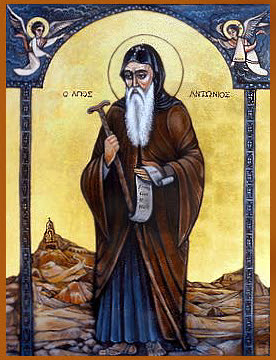
St. Anthony of the Desert

Our family has always felt an intimate attachment to St. Anthony of the Desert.  This is, perhaps, odd. In one sense, it would be hard to imagine a personage more remote from our own lives than Anthony: He lived in the 3rd and 4th Centuries on the fringe of the world in the Nitrian Desert, battling demons and consuming insects, and his brief interactions with others were primarily restricted to those who were at least as mad as he was.  However, perhaps it is this very remoteness which finds such a kinship in our lives.  Perhaps we need such reminders of what madmen we in fact are called to be, in the very radicality of our Faith.  As for consorting with the insane, several members of the family fit the bill.

In his colorful and much too short account of the great desert saint and father of monasticism, St. Athanasius describes the last moments of St. Anthony's life:

"Having summoned those who were there--they were two in number who had remained in the mountain fifteen years, practising the discipline and attending on Antony on account of his age--he said to them, 'I, as it is written, go the way of the fathers, for I perceive that I am called by the Lord, And do you be watchful and destroy not your long discipline, but as though now making a beginning, zealously preserve your determination. For ye know the treachery of the demons, how fierce they are, but how little power they have Where fore fear them not, but rather ever breathe Christ, and trust Him. Live as though dying daily. Give heed to yourselves, and remember the admonition you have heard from me. Have no fellowship with the schismatics, nor any dealings at all with the heretical Arians. For you know how I shunned them on account of their hostility to Christ, and the strange doctrines of their heresy. Therefore be the more earnest always to be followers first of God and then of the Saints; that after death they also may receive you as well-known friends into the eternal habitations... Bury my body, therefore, and hide it underground yourselves, and let my words be observed by you that no one may know the place but you alone. For at the resurrection of the dead I shall receive it incorruptible from the Saviour. And divide my garments. To Athanasius the bishop give one sheepskin and the garment whereon I am laid, which he himself gave me new, but which with me has grown old. To Serapion the bishop give the other sheepskin, and keep the hair garment yourselves. For the rest fare ye well, my children, for Antony is departing, and is with you no more.'


 Having said this, when they had kissed him, he lifted up his feet, and as though he saw friends coming to him and was glad because o them--for as he lay his countenance appeared joyful--he died and was gathered to the fathers. And they afterward, according to his commandment, wrapped him up and buried him, hiding his body underground. And no one knows to this day where it was buried, save those two only. But each of those who received the sheepskin of the blessed Antony and the garment worn by him guards it as a precious treasure. For even to look on them is as it were to behold Antony; and he who is clothed in them seems with joy to bear his admonitions."

St. Anthony has been the inspiration of many, and we are especially fascinated by the artwork throughout the ages that depicts various moments in his life. Artists seem to be especially interested in his battles with demons (and understandably so). Here are just a few of the paintings of these momentous desert battles, from Michelangelo to Dali:

"The Torment of Saint Anthony"--and Michelangelo's oldest known painting, c. 1487-1488


"Temptations of St. Anthony" by Bernadino Parenzano, c. 1494
"The Temptation of St. Anthony"; Jacopo Tintoretto; c. 1577


"The Temptation of St. Anthony"; Paul Cezanne; 1875

"The Temptation of St. Anthony"; Salvador Dali; c. 1946


And it appears that these epic encounters are also inspiring to cooks. In Spain, it is the tradition to cook "Olla de San Anton," a soup that uses virtually every part of a pig that is available in butcher shops, including the blood. This tradition is based on the legend that the devil often appeared to St. Anthony in the form of a pig. Here's a traditional recipe we would like to make some day, when blood sausage is as common as it should be in American meat markets and grocery stores. Forgive the awkward translation; its from a Spanish site:

Ingredients:
  • 1/2 Kg of dry broad-bean
  • 200 g of white beans
  • 1 onion
  • 1 sweet pepper
  • 1 garlic
  • 1 bone of marrow
  • 1 bone of ham
  • 200 g of pork ribs
  • 200 g of fat streaky bacon
  • 1 pork ear
  • 1 pork tail
  • 1 thyme branch
  • 2 fennel leaf
  • 2 rice glass
  • 3 potatoes
  • salt
  • blood sausage
Preparation:
Soak the broad-beans and the beans the day before. 
Peel the onion and cut it in two parts, wash the bones of marrow and ham, and put the ingredients (except the bloody sausage, the rice, and the potatoes), in a pot full of water. Let it cook slowly for one hour and half. 
During this time, peal the potatoes and cut it in pieces, drop it in the pot with the rice and the bloody sausage.
Let cook twenty minutes more and serve it hot.

For those of us who don't have easy access to pig ears, feet and blood, here's a tamer recipe that we make from the book Monastery Soups. The original recipe is vegetarian, but we like to add pork sausage or chorizo on this particular feast day. 

INGREDIENTS:

3 tablespoons oil of choice
1 cup barley
1 carrot, finely grated
2 leeks, sliced
1 bay leaf
1/3 cup fresh parsley, minced
salt to taste
7 cups water
1 bouillon cube (or you can use broth in place of the water)
chopped mushrooms
1 pound pork sausage or chorizo

DIRECTIONS:

1. Heat the oil in a soup pot and add the barley, stirring continuously for one minute. Immediately add the carrot, leeks, bay leaf, parsley, salt, and water.
2. Cook the sausage in a separate skillet and add to the soup.
3. Cook the soup over low to medium heat, covered, for 40 to 45 minutes, until the barley is tender. Add more water if needed. For extra taste, add the bouillon and the mushrooms during the last 20 minutes of simmering. Remove the bay leaf. Serve hot.

St. Anthony the Great, Pray for Us!

Friday, January 13, 2012

Land and Liturgy


Anyone who has followed this blog since we started back in November can probably tell that we are interested in getting "back to the earth." Although we're not currently in a place where we can truly live the agrarian life, it is a family aspiration that we pray will be fulfilled someday. We often find ourselves longing for the day when we can truly immerse ourselves in the earth and face the challenges and joys that it will bring.

In the meantime, we have plenty of things to learn that don't require a plot of land. We have already begun to discover the joy that comes from working as a family. Even simple activities like brewing beer, baking bread and canning have already drawn us closer to one another and enriched our spiritual life. To my mind, this is where the old dichotomy between soul and body begins to fall apart. The soul of our family is enlivened by these earthy, bodily activities. It is a new way of discovering Christ, of encountering His presence in day-to-day life.

As expressed in this great blog post by D. Rose, however, the desire to live the agrarian life and do "old fashioned" things isn't simply an attempt to step back in time. What is attractive about the agrarian life isn't only its deep connection with the land and bygone days. To my mind, one of the things that makes the agrarian life most attractive is its connection to the Catholic liturgical year. In our fast-paced society, rife with deadlines, networking and constant communication, it can be so difficult to establish any kind of rhythm. What I notice about the lives of men and women of old is that their lives were regulated by liturgy, and that the liturgy was, more frequently than not, in dialogue with the seasons. The liturgy was not a detached "issue" that one could converse and read about. It was not just something that happened on Sundays and Holy Days. The liturgy informed each and every day of the year. To be "in season" was not simply a statement of fashion; rather, the seasons were seen as themselves liturgical.

To put it more clearly, living the agrarian life seems to provide at least some protection against the  "formlessness" of modern living, as  A. Ellison of Catholic Phoenix puts it so perfectly. To live in accordance with the cycles of the seasons, in a strange combination of self-sufficiency as well as absolute dependence on the yield of earth and sky...what could be more opposed to the open-ended, "on demand," anything-goes metronome that is, so often, modern life? And would this not be more conducive to submission to Providence than the illusion of endless creativity?

To that end, we're happy to enter into the newest rhythm of the liturgical season:


Yes, Carnival!! (But no, not that kind of carnival. The term actually derives from the Latin, "Carne--vale!", or "Meat---farewell!") This "unofficial season" is perhaps more tied to the flesh than to the land. As noted at Fish Eaters, during carnival " Catholics want to eat while they can and get the frivolity out of their systems in preparation for the somber Lenten spirit to come." The carnival season begins after the feast of the Epiphany and continues until Shrove Tuesday, or the day before Ash Wednesday (otherwise known as "Mardi Gras"). During this time, the Church calls her members to celebrate with dancing, social events, and of course, good food and drink. 

Naturally, as noted at New Advent, "It is intelligible enough that before a long period of deprivations human nature should allow itself some exceptional licence in the way of frolic and good cheer. No appeal to vague and often inconsistent traces of earlier pagan customs seems needed to explain the general observance of a carnival celebration." Apparently the Italians were especially prone to carnival excesses, so much so that Pope Benedict XIV instituted a plenary indulgence for anyone in the Papal States who took part in the Exposition of the Blessed Sacrament for three days during carnival season. As for our family, we plan to enjoy a lot of hearty beef stews, expand our knowledge of cheese and, of course, continue to enjoy our Christmas brew (which is still a little green, but hopefully it will finish up before Lent begins!) 

Happy Carnival everyone!


Tuesday, January 10, 2012

Blessing of Homes

A few posts back, we mentioned the blessing that we always pray when we finish a batch of beer.  This past Sunday was the feast of the Epiphany, and one of the oldest traditions for the feast is to bless your home. Although the feast of the Epiphany is the traditional time to bless your home, you can do it at any time of the year. The blessing can be done either by a priest or by the father of the family. If possible, have the incense, holy water and chalk blessed beforehand. We found this great blessing of homes at FishEaters.com:

Priest/Father:
Peace be to this house.
All:
And to all who dwell herein.
Priest:
From the east came the Magi to Bethlehem to adore the Lord; and opening their treasures they offered precious gifts: gold for the great King, incense for the true God, and myrrh in symbol of His burial.
All:
My soul doth magnify the Lord, and my spirit hath rejoiced in God my Savior. For He hath regarded the humility of His handmaiden. For behold, from henceforth all generations shall call me blessed. For He that is mighty hath done great things to me, and holy is His Name. And His Mercy is from generation unto generations upon them that fear Him. He hath shewed might in His arm, He hath scattered the proud in the conceit of their heart. He hath put down the mighty from their seat, and hath exalted the humble. He hath filled the hungry with good things, and the rich He hath sent empty away. He hath received Israel, His servant, being mindful of His mercy. As He spoke to our Fathers, Abraham and His seed forever.
All:
From the east came the Magi to Bethlehem to adore the Lord; and opening their treasures they offered precious gifts: gold for the great King, incense for the true God, and myrrh in symbol of His burial.
Priest:
Our Father Who art in Heaven, hallowed be Thy Name. Thy Kingdom come, Thy will be done on earth as it is in Heaven. Give us this day our daily bread, and  forgive us our trespasses as we forgive those who trespass against us. And lead and lead us not into temptation,
All:
But deliver us from evil.
Priest:
All they from Saba shall come
All:
Bringing gold and frankincense.
Priest:
O Lord, hear my prayer.
All:
And let my cry come unto Thee.
Priest:
Let us pray. O God, who by the guidance of a star didst on this day manifest Thine only-begotten Son to the Gentiles, mercifully grant that we who know Thee by faith may also attain the vision of Thy glorious majesty. Through Christ our Lord.
All:
Amen.
Priest:
Be enlightened, be enlightened, O Jerusalem, for thy light is come, and the glory of the Lord is risen upon thee-- Jesus Christ born of the Virgin Mary.
All:
And the Gentiles shall walk in thy light and kings in the splendor of thy rising, and the glory of the Lord has risen upon thee.
Priest:
Let us pray. Bless, O Lord God almighty, this home, that in it there may be health, purity, the strength of victory, humility, goodness and mercy, the fulfillment of Thy law, the thanksgiving to God the Father and to the Son and to the Holy Spirit. And may this blessing remain upon this home and upon all who dwell herein. Through Christ our Lord.
All:
Amen.

After the prayers of the blessing are recited, walk through the house and bless each room by sprinkling with Epiphany water and incensing it.

Take the blessed chalk and first write the initials of the three Wise Men, connected with Crosses, over the inside of your front door (on the lintel, if possible). Then write the year, breaking up the numbers and the year so that they fall on both sides of the initials. It should look like this, for ex.:

20  C+M+B  05

with the "20 "being the millennium and century, the "C" standing for the first Wise Man, Caspar, the "M" standing for Melchior, the "B" standing for Balthasar, and the "05" standing for the decade and year. It is also popularly believed that the Kings' initials also stand for "Christus mansionem benedicat" ("Christ bless this house").


A blessed 2012 to all our readers!

Friday, December 30, 2011

The Family As Icon

A few years ago I remember hearing a homily about the Holy Family. Rather than addressing the beautiful strangeness of the iconic family of Jesus, Mary and Joseph, the primary emphasis was on their normality. "They were just a normal family, just like you and me," or something along those lines. Yes, just like us, the members of the Holy Family were only human.


I remember being a bit puzzled by this homily. Yes, it's true that the Holy Family was composed of human beings, just like any other human family. But were they really normal? Were they typical? My suspicion is that they were anything but. After all, both parents were visited by angelic beings on several occasions. And although their son was fully human, He was also fully...divine. So why emphasize the normality of this truly exceptional family?

In his 1994 "Letter to Families," Pope John Paul II expresses what I think, to a certain extent, is at risk in  this treatment of the Holy Family. He says:

"Unfortunately various programmes backed by very powerful resources nowadays seem to aim at the breakdown of the family. At times it appears that concerted efforts are being made to present as "normal" and attractive, and even to glamourize, situations which are in fact "irregular". Indeed, they contradict "the truth and love" which should inspire and guide relationships between men and women, thus causing tensions and divisions in families, with grave consequences particularly for children. The moral conscience becomes darkened; what is true, good and beautiful is deformed; and freedom is replaced by what is actually enslavement."

What struck me as dangerous about the assertion that the Holy Family was "normal" was that the modern definition of the normal family has been dramatically altered. As Blessed John Paul II states, irregularity is now considered the norm. Just watch a few modern sitcoms and it's obvious. Although family situations like same-gender parents are obviously irregular from a Catholic perspective, they aren't necessarily considered to be out of place from a secular standpoint. In fact, a refusal to tolerate these arrangements and label them as acceptable may be one of the few modern vices, or to put it less "religiously," weaknesses.

What is even more frightening about this change is what Blessed John Paul II refers to in his homily: that is, that "what is true, good and beautiful is deformed..." The irregular instances that demonstrate the breakdown of the family are considered not only to be acceptable, but also desirable and attractive. Truly happy families are looked down upon with scorn.  After all, any family who seems that happy must have some dark, deep secret, right? We are unable to accept the beautiful as it is. We delight more in the twisted perversions that lie beneath the appearance of beauty. Horror movies wouldn't be nearly as popular if this weren't the case.

The tendency to shrink away from beauty and perfection in the religious sense manifests itself in more subtle ways, too. I, for one, feel enormous peer pressure to present my family as normal. Ask anything else of your family and you'll probably be called pretentious or snobbish. Catholics in particular must be on guard against this mindset. After all, are we not called to be perfect as our Heavenly Father is perfect? Here's a story to illustrate my point. My husband and I chose a little-known Scots Gaelic name for our firstborn daughter. Although her name does have symbolic significance, she is not named after a canonized saint. When Catholics ask if there is a saint with the same name, my husband will often reply, "Not yet." The first time he said this, the questioner (who also happened to be a Catholic) was absolutely horrified. After all, he said, who are we to hope that our children will one day be saints?

And yet isn't that what we should hope for them? To be saints, to be the intimate friends of God, is what should define the family. It is what should motivate all our actions, words and thoughts. The Holy Family was, after all, "only human." But this does not simply normalize sanctity; rather, it elevates our humanity. This elevation is a calling, something to which we as families must respond. In a perfect world--in the New Creation--the Holy Family is, indeed, the norm. Until then, we less-than-holy families should strive not for normality, but for radical difference...yes, for perfection.

Thursday, December 29, 2011

Castrating the Holy Innocents


A new sort of news has become startlingly frequent in the media during the days surrounding Christmas. Specialists: psychologists, psychiatrists, analysts, therapists, journalists (who seem to be able to assimilate all of the aforementioned areas of expertise), and all other -ists, have gathered together in a grand alliance and their message is brave.  It is certainly new.  Well sort of.  At least it is worldly.

It seems (certainly unbeknownest to ourselves, but really only because of how we have been educated) that parents are the single greatest threat to their children's freedom.  The Ists concur: it is a scientific fact.  For instance, and most relevant to recent media enlightenments, parents are the primary historical cause for the continuation of the last great social myths: gender roles.


Yes, ladies and gentlemen, according to media reports, we parents have treated our boys and girls like... well...boys and girls.  Yes, it sounds absurd when you put it like that. But to suggest that the Ists are just that--evidently absurd--cannot be fair.  Right?  Hm.

Perhaps the problem is in our language!  Perhaps if our ancestors had been as enlightened as our Journalists they would have never developed the words "boy" and "girl" to begin with.  So here then is the charge of the Ists:  we parents have been treating some of our Its like boys and then some of our Its like girls.  Now that sounds much less absurd.

We have been cookie cutting our Its into the form of our own inherited traditional, cultural outdated social norms.  But this is not fair to the Its!  This will cause suppression and/or depression.  The Its should be allowed to be free, to freely choose their own identity.  We do not want them to find themselves, we want them to create themselves.

The assumption here of course is that life is not a gift, with inherent purpose and meaning.  Freedom is not the ability to pursue one's purpose.  Life is a void and to be free is to be unformed within that void.

The assumption is that bodies are meaningless.   Our children's bodies are meaningless.  Their bodies are disconnected from themselves, identities which must be thought of as some dislocated ego floating in a void.

Of course I am then left with a question: according to this brave new line of thinking, how can we as parents protect our Its' freedom?

Clearly, we do not want them to receive any sort of  outside influence (it is never the case that a lack of influence is itself influential on a child's development).  This would immediately impede upon their freedom.  We would never want to engender them with our own "values", convictions, beliefs, customs, traditions (which of course were not themselves ultimately given to us but which our ancestors created out of thin air), etc.  We must always speak vaguely and non-objectively when the Its are present.

We should also hide their genitalia from them.  It is simply too dangerous to their freedom for them to ever come into contact with sexual difference.  They might, once they noticed this difference, develop words to distinguish these differences, like "womanhood" or "manhood."  They might think, since children often innocently believe that things have purposes (idiots), that this difference actually meant something and that they were called to respond to this meaning.

If they noticed such a seeming contradiction between their bodies and what we told them, they might think that we were trying to hide this meaning from them, that we were trying to force them into a matrix of genderless sterility, that we were trying to take their bodies away from them, that we were depriving them of purpose, that they were left without meaning and feel pressured to generate new and strange identities to compensate for this deprivation.  They might believe that they now lived in a totalitarian regime.

Monday, December 26, 2011

Killing Wrens, Racing Horses for Ale


St. Stephen's Day is an important feast in the liturgical calendar and is associated with a great deal of customs from various places.  Perhaps most well known is Boxing Day (British).  As a child I always used to imagine that this was a day on which people would simply slug each other. Although, incidentally,  it used to be that people would strike each other with holly branches throughout the day, in actual fact, Boxing Day is a time of almsgiving on which one would give boxes of money, gifts or food to servants or the less fortunate.  This is commemorated in the story of Good King Wenceslas, who travels with his servant through the cold and snow to give alms to a peasant family.


This story is told in the famous carol "Good King Wenceslas" which it is customary to sing on this day: 

Good King Wenceslas looked out
On the feast of Stephen
When the snow lay round about
Deep and crisp and even
Brightly shone the moon that night
Though the frost was cruel
When a poor man came in sight
Gath'ring winter fuel.

"Hither, page, and stand by me
If thou know'st it, telling
Yonder peasant, who is he?
Where and what his dwelling?"
"Sire, he lives a good league hence
Underneath the mountain
Right against the forest fence
By Saint Agnes' fountain."


"Bring me flesh and bring me wine
Bring me pine logs hither
Thou and I will see him dine
When we bear him thither."
Page and monarch forth they went
Forth they went together
Through the rude wind's wild lament
And the bitter weather


"Sire, the night is darker now
And the wind blows stronger
Fails my heart, I know not how,
I can go no longer."
"Mark my footsteps, my good page
Tread thou in them boldly
Thou shalt find the winter's rage
Freeze thy blood less coldly."


In his master's steps he trod
Where the snow lay dinted
Heat was in the very sod
Which the Saint had printed
Therefore, Christian men, be sure
Wealth or rank possessing
Ye who now will bless the poor
Shall yourselves find blessing 

It was a commonplace tradition to go hunting on St. Stephen's Day.  The most popular game animal was the wren (although fox hunting was also common) who was believed to be guilty of betraying St. Stephen and also represented the old year.  Whole families would go out to picnic during the hunt, bringing with them the makings for a great feast from Christmas leftovers.  The wren would later be processed through the villages on a pole and the hunters would go from door to door requesting funds for a proper funeral.

In many areas of Europe, Stephen is associated with horses.  For this reason it was always customary, especially in Eastern and Northern Europe to engage in horse racing.  Similarly, bands of men, calling themselves St. Stephen's Men, gallop through the villages singing about St. Stephen.  In return, the villagers would supply them with a breakfast of ale.  St. Stephen's Day bread would also be baked, in the shape of a horseshoe and filled with jam or a poppyseed sauce.


Saturday, December 17, 2011

Lazarus, Come Forth!


Here's a poem to honor the Biblical saint, whose feast day we remember today:
The Convert

BY G. K. CHESTERTON
After one moment when I bowed my head
And the whole world turned over and came upright,
And I came out where the old road shone white.
I walked the ways and heard what all men said,
Forests of tongues, like autumn leaves unshed,
Being not unlovable but strange and light;
Old riddles and new creeds, not in despite
But softly, as men smile about the dead


The sages have a hundred maps to give
That trace their crawling cosmos like a tree,
They rattle reason out through many a sieve
That stores the sand and lets the gold go free:
And all these things are less than dust to me
Because my name is Lazarus and I live.

Saint Lazarus, Friend of Christ, Pray for Us!

Wednesday, December 14, 2011

Another Forgotten Fast

Yes, I know, feast days with edible eyeballs and churches made out of bones may be more exciting than fast days. But it's amazing to me that an ancient fast that was traditionally observed several times throughout the year has been all but wiped out in contemporary Catholicism. The traditional observance of Ember Days is a beautiful custom that I had never even heard of until very recently (as in last week).

As noted in this great post over at the New Liturgical Movement's blog, the Ember Days fast dates back to New Testament times. Like many feasts and fasts, Ember Days was originally intended as a tribute to the bounty of the Earth and the cycles of the seasons. They were traditionally held in the winter, spring, summer and autumn months. The winter Ember Days fall on the Wednesday, Friday and Saturday following the feast of Saint Lucy (December 13). The fasts repeat in Lent, after Pentecost and in September. As noted in the great text, "The Golden Legend," a bestseller of the medieval period that dates back to 1275:

"Then let us fast in March which is printemps for to repress the heat of the flesh boiling, and to quench luxury or to temper it. In summer we ought to fast to the end that we chastise the burning and ardour of avarice. In harvest for to repress the drought of pride, and in winter for to chastise the coldness of untruth and of malice." 

The three fast days this week are also characterized by special devotions: thanksgiving on Wednesday, repentance from sin on Friday and charity on Saturday. Interestingly, for all those readers who are familiar with the temperaments, the winter fast is also meant to purify the phlegmatic tendency, which was believed to be especially dominant in the winter months. Again, Jacobus de Voraigne phrases it perhaps most appropriately: "In winter we fast for to daunt and to make feeble the phlegm of lightness and forgetting, for such is he that is phlegmatic."

Now that I know about this fast I've found that there's actually quite a bit of literature on it. In fact, I encountered a passage in Sigrid Undset's series "The Master of Hestviken" just the other day that refers to it: 

"Some days after, he had business that took him inland, and Eirik was to accompany him as far as the church; it was a Wednesday in the ember days, and Sira Hallbjorn [a priest] insisted that all who could should attend church in the ember days." 

For readers who don't know, the books take place in medieval Norway and are rife with Catholic imagery and themes. I was so excited to find this reference to the Ember Days. Isn't it amazing that what was once a commonplace custom is now virtually unknown?

Anyway, although there may not be special recipes to mark these fast days, we can observe them with prayerfulness and our own attempts at mortification (although the medievals certainly have us beat when it comes to that as well...but that's another post). After all, what fun is feasting without fasting?


Tuesday, December 13, 2011

Eating Lucy's Eyeballs


St. Lucy Queen of Lights


As Catholics (especially cradle Catholics) we are admittedly macabre.  I do not say "perceived to be" or "seemingly" macabre.  You cannot be a true Catholic if you are not authentically macabre.  The fact the most people have a purely negative association with the term only serves to demonstrate that most people are not Catholic, or, at the very least, that we have relinquished any level of Catholic vocabulary.  The word "macabre" is itself macabre.  It stems from Old French and is derived from the originary meaning 'dance of death', a miracle play depicting the slaughter of the Maccabee Brothers.  This hidden origin of the word is a perfect example of the traditional Catholic acquaintance with the gruesome.  We have churches composed of bones (Sedlec Ossuary in the Czech Republic or Santa Maria della Concezione dei Cappuccini in Rome for instance) statues of saints proudly bearing their own murder/torture implements (my favorite perhaps being St. Bartholomew with his flayed skin) and of course the stories are endless (think St. Lawrence: "Turn me over I'm done on this side"-patron saint of Barbeques).  Most obviously, we Catholics proudly bear the death instrument  which mangled Our Lord as our most evident symbol.  Indeed, we refuse to tidy this image up by removing Christ from the cross.  Give us a chance and we will likely try to paint on a bit more blood.   We are macabre, and I do not think this fact should be lost upon us.  Of course we wish to instigate a culture of life, but always, in defending life we find ourselves defending the potential beauty and meaning within suffering.  Truly, our celebration of the macabre is always a dance of hope.


December 13 is St. Lucy's day, a macabre celebration, second in some ways only to Dia de Muertos.  Lucy was martyred during the reign of Emperor Diocletion.  A Sicilian, she is yet another example of a beautiful Christian virgin who is set on causing trouble for her suitors.  In one version of the story a suitor complimented her on her beautiful eyes.  Never a timid creature, Lucy cut her own eyeballs out and sent them to the suave fellow so he would kindly leave her be.  The tamer version has Diocletion's soldiers doing the deed, but either way she has consequently become the patron saint of eye diseases and blindness.  She is portrayed happily toting her eyeballs, sometimes on a plate or other times (such as in the image above) between her fingers.


Lucy is especially popular in Scandinavia and Italy, where her feast day is celebrated with torchlight processions and bonfires. Italians make and eat cakes or biscotti shaped like eyeballs to honor St. Lucy's memory. Sicilians abstain from anything made with wheat flour on her feast day and eat potatoes or rice instead. This practice is in honor one of Lucy's many miracles. In 1582, during a severe famine, Lucy made a fleet of grain-bearing ships appear in the harbor.  The people promptly ate the grain without preparing it in the normal fashion. In Palermo, a dessert called cuccia is made out of whole-wheat berries and ricotta.


The Scandinavian celebration of St. Lucy's day revolves primarily around the meaning of her name, which makes sense considering the country's dreadful, dark winters. As parents, we particularly appreciate this custom: According to tradition, the oldest or youngest daughter wakes up before sunrise to serve her family a delicious feast of treats like lussekatter (Lucy cats), saffron-flavored buns, ginger biscuits and cross shaped pastries, as well coffee or, even better, hot spiced wine with aquavit. She dresses in a long white gown with a red sash and wears a crown of greens topped with anywhere from four to nine lighted candles.


 Glögg

Yield. Makes about five 750 ml bottles
Preparation time. About 90 minutes
Ingredients
1.5 liter bottle inexpensive dry red wine
1.5 liter bottle inexpensive American port
750 ml bottle inexpensive brandy
10 inches cinnamon stick
15 cardamom seed pods or 1 teaspoon whole cardamom seeds
2 dozen whole cloves
1 orange peel, whole and washed
1/2 cup dark raisins
1 cup blanched almonds
2 cups sugar
Garnish with the peel of another orange

Directions

1) Crack the cardamom seed pods open by placing a pod on the counter and laying a butter knife on top of it. With the palm of your hand, press on the knife. They will crack it open so the flavors of the seeds can escape.
2) Pour the red wine and port into a stainless steel or porcelain kettle. Do not use an aluminum or copper pot since these metals interact with the wine and brandy to impart a metallic taste. Add the cinnamon, cardamom, cloves, orange peel, raisins, and almonds. Cover and simmer.
3) Put the sugar in a pan and soak it with half the brandy. Warm over a medium-low flame and stir occasionally until it becomes a clear, golden syrup and all the sugar is dissolved. Let it simmer for about 15 minutes until the little tiny bubbles become large burbles. This starts caramelizing the sugar and adds a layer of flavor.
4) Add the sugar syrup to the spiced wine mix. Cover and let it simmer over a low heat for an hour.
5) Taste. If you wish, add more sugar or brandy to suit your taste. If you do, go easy, 1/4 cup at the most. 
6) Just before serving, strain to remove the spices, almonds, and raisins. You can serve your glögg immediately or bottle it and age it. A month or two of aging really enhances the flavors. A year is even better. If you are going to age glögg, use wine or whiskey bottles and make sure they are clean. Bottle glögg while it is still warm. Fill the bottles as high as possible and seal them tight. You don't have to lie them down to age, and if you use used corks, they might leak where the corkscrew entered if you lie them down.
7) Fringe benefits. Do not discard the raisins and almonds when you are done, they are impregnated with flavor! I put the raisins in a jar in the refrigerator to use in pannetone or other desserts, or toast the almonds in a 225F oven for about 90 minutes and eat them as snacks.
8) Serving. To serve glögg, warm it gently in a saucepan over a low flame or, better still, in a crockpot. Serve it in a mug and, don't skip this, garnish it with a strip of fresh orange peel, twisted over the mug to release the oils. 

Monday, December 12, 2011

Nuestra Senora de Guadalupe

One of the most striking aspects of the story of Our Lady of Guadalupe is its simplicity. Juan Diego is a humble farmer, recently converted to the Catholic Faith. The task that Our Lady asks of her "dear little son"--to build, in Our Lady's words, "a church in this place where your people may experience my compassion"--is a relatively simple request. When I read the story of Our Lady of Guadalupe I am always amazed at the momentous impact it has had on the Catholic world. Centuries later, the miraculous image of Our Lady of Guadalupe is so well-known that you can purchase candles bearing its likeness at major superstores.

And yet the story also reveals a strange paradox: simplicity is not always easy. It is not merely a lack of effort. To accomplish a simple task can, as in the case of Juan Diego, require the miraculous. In our age of modern convenience, we must be especially aware of this paradox. Too often we settle for the easy way out with the illusion that we live "the simple life." Perhaps the most obvious example is in the realm of food. Easy, convenient food is not the same thing as simple food. Easy food can be warmed up in seconds in a microwave. Simple may food take hours, days, even years to stew, roast, brew...it is often inconvenient and rarely quick.  May Our Lady of Guadalupe and Saint Juan Diego give us the persistence to "keep it simple," even if it requires a bit of extra effort.

+

To celebrate this feast day, here is a simple (and easy) recipe for Mexican hot chocolate that also makes a delicious winter treat:


3 cups hot cocoa mix
1 teaspoon nutmeg
3 teaspoons cinnamon
Pinch of cayenne pepper

Mix all the ingredients together. Warm some water, or use milk for creamier hot chocolate. Use about 3 heaping tablespoons per one cup of liquid. Serve with a cinnamon stick, whipped cream and grated Mexican chocolate or mini chocolate chips.

Our Lady of Guadalupe, Empress of the Americas and of All Unborn Children, Pray for us.


Sunday, December 11, 2011

The Christmas Tree Dilemma

It is immensely difficult to observe the Advent season properly, as the rest of the world celebrates a premature, commercially driven Christmas.  I have frequently heard people complain that by the time Christmas arrives they are sick of the music, sweets and culture associated with a season they have only just reached.  Somehow none of this can trespass on those sacred moments when the family is circled around the advent wreath, warmed by the tiny flames of expectation, and singing "O Come O Come Emmanuel."  Still, it can be difficult to gauge how best to live in the world but not of the world during this time.

One important decision to be made regards what is for most a prime symbol of Christmas: the Christmas Tree.

Like so many of our traditions, the Christmas Tree most likely finds its roots in pagan culture, where evergreen plants were used during the Winter Solstice to signify the power of life over death.  Tradition tells of St. Boniface, who traveled as an English missionary to the Germanic tribes in the 8th Century, as being the progenitor of the Christmas tree tradition.  The pagans were accustomed to making sacrifices to the Norse god Odin before a great oak tree.  The tale goes that Boniface came upon a pagan rite in which a young boy was about to be sacrificed to the god.  Boniface took his axe and felled the oak in one stroke, saving the boy.  An evergreen tree sprang up from where the oak had been and Boniface declared that this was the tree of life and that it represented Christ.

Certainly from around the Sixteenth Century pine trees were brought indoors and decorated on Christmas Eve for the twelve days of Christmas.  However, tragically, Western Culture has lost its liturgical framework, Advent has culturally perished and "Christmas" has devoured itself out of any religious significance..  Now of course it is customary to have a neighborhood race to see who can have their tree up and decorated first following Thanksgiving.  I noticed several people cheating this year and putting their trees up a week before Thanksgiving.  As in so many arenas the Catholic is always slowed down in this particular competition by a healthy twinge of conscience.  The Catholic knows that in fact most everyone is cheating because the race does not start until Christmas Eve.  However, as is often the case, it is difficult, even dangerous to do things properly.  Two years ago we decided to wait until Christmas Eve to buy a tree.  Much to my dismay, all of the tree vendors had packed up and left.  After combing the town for hours, I finally found a Home Depot that was giving trees away for free which were being prepared to be trashed.  As Providential as this seemed at the time, I prefer not to leave things up to chance every year.

So who cares when people whip out their plastic blinking hypnotic nightmarish flora replicas?  The problem is that the Christmas tree is a sacramental.  We need to fight to preserve, cherish and protect the beauty, the power and the meaning behind this very special monstrance of hope.  That is, after all the origin of the Christmas tree.  Sound ridiculous?  Guess that goes to show how much ground we have lost, but we can win it back, at least for our families.

So what to do about the Christmas tree dilemma?  We have settled into a tradition of buying our tree on Gaudete Sunday and then keeping it outside until Christmas Eve.  Society isn't structured to assist the liturgical pursuit, but you can box back.

Saturday, December 10, 2011

Brewing Day Two


"I should like a great lake of ale, for the King of the Kings. I should like the family of Heaven to be drinking it through time eternal." ~ St. Brigid.


Saint Brigid (feast day February 1) is one of the many patron saints of beer and brewers.  She is usually remembered for her important role during the early moments of Christianity in Ireland and her founding of the monastery of Kildare.  Of greater interest to me, however, is her deep respect and love of beer.  Indeed many of her miracles directly involve ale.  Once, for instance, she was able to supply eighteen churches with beer from Maundy Thursday to the end of the Easter Season with one barrel of her private stock. Another time, while visiting a leper colony, she found to her great dismay that the lepers were so wretched that they did not even have any beer.  With an abbess' great sense of economy, she used dirty bathwater as the medium for her miracle: "For when the lepers she nursed implored her for beer, and there was none to be had, she changed the water, which was used for the bath, into an excellent beer, by the sheer strength of her blessing and dealt it out to the thirsty in plenty." This is not the only time that she utilized bathwater for this very same purpose.  Brigid is said to have changed her own dirty bathwater into ale for visiting priests when she   found her supply exhausted.   
+

The Christmas ale has, for all intents and purposes, finished fermenting in the primary fermentor and now it is time to transfer the ale to a carboy for the secondary fermentation process.


1.)  Sanitize your carboy carefully, as well as your racking hose.


 2.)  Fill your racking hose with water so as to begin the racking (siphoning) process.


3.)  Rack into a separate container until the water has cleared the hose.


4.)  Rack the beer into the carboy.


5.)  Add two vanilla beans, two sticks of cinnamon and one tablespoon of shaved ginger.


6.)  Put lid and airlock 
in place.


7.)  Store in dark cool area for about five days.